If you have obsessive-compulsive disorder (OCD), you probably don’t always love how it’s portrayed in TV shows, movies, books, commercials, jokes, daily life—anywhere, really. Thankfully, representation has gotten better and more accurate in recent years, due in large part to people with OCD creating meaningful projects that are touching and beautiful as well as educational. Today’s guests, Tyler Falcoa and Mitch Francis, have already made one short (and incredible) film about OCD, Do You Know How to Turn Off the Lights?, and are now working on a second one, Sorry I’m Late. Read on to learn more about both projects in their own words, including how you can support the production of Sorry I’m Late.

First, tell me a little about yourselves! Tyler, you have OCD, which you’re very open about as an IOCDF Advocate and host of the podcast Please Excuse My OCD. What made you decide to start spreading awareness? Was it scary?
Tyler: OCD has always been the wizard behind Oz in my life since I was a child. I first became “diagnosed” at the age of 10 after a traumatic football injury and house fire; however, I never really understood my OCD was what it was until I was 19 when my pediatrician pointed out that my horrific harm and suicidal intrusive thoughts were actually a symptom of my OCD. I got on medication at that time, but I still struggled with OCD throughout my 20s. It wasn’t until I learned about ERP, and unfortunately had done it by myself, where I started to notice changes in my life. I got my start being publicly open about my OCD in 2019. My brother Ryan, Mitch, and I had been very successful in building a YouTube music page, but we wanted to add something different to it. I had just gotten out of a six-month flare-up of existential OCD, and Mitch had asked me if I would be open to making a small documentary about it for the channel. We had no idea if people would care, but it turns out they very much cared. Fast-forward to 2024, I started the podcast Please Excuse My OCD, which gained quite a bit of support from others in the OCD community. I felt so welcomed by everyone who not only wanted to share their stories on the podcast but also help raise awareness within their own lives. It was the first time in my life where I truly felt understood. While there was some fear, I truly never felt like I was making the wrong decision by opening up about my OCD story publicly.
You’ve already made a short film about OCD, Do You Know How to Turn Off the Lights? What inspired it? How did your collaboration come about?
Tyler: I had written a spoken word in my Notes app on my phone one day for no reason at all but to simply see my thought process in front of me when I go through my bathroom routine when washing my hands. I figured if anything it could be a spoken word that I record and release on the podcast. I sent it to Mitch to see what he thought about it and he suggested we turn it into a full-on film.
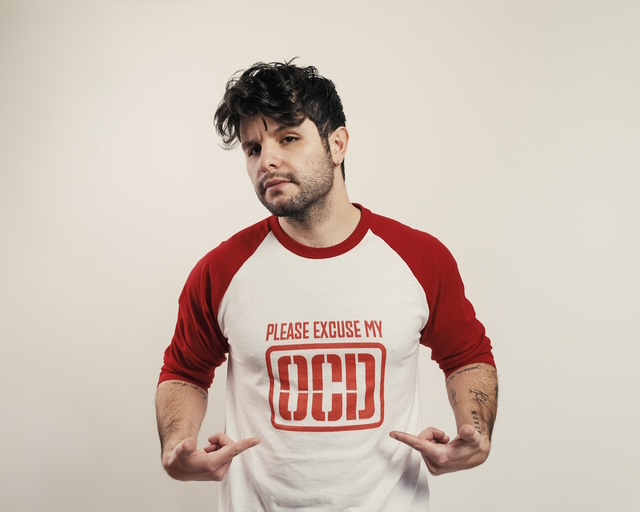
Mitch: Tyler and I have worked together closely for years on different creative projects. When he sent me the poem he had written about OCD, I saw it in my head as I read it. I said we should make this into a film. He loved the idea. So I took the piece and adapted it into a screenplay and we made the film with just us two.
Now you’re working on a second film, a prequel to Do You Know How to Turn Off the Lights? You’ve said you plan to go all in on this one—one difference is that it will be longer than the first one, which was about five minutes long. What else can viewers expect this time around?
Mitch: With Sorry I’m Late, we’re expanding the world of the first film, both visually and emotionally. Do You Know How to Turn Off the Lights? took place entirely in one room, showing a single, isolated OCD spiral. This time, we’re stepping outside that space and following Tyler through an entire evening, seeing how those thoughts and rituals follow him into the real world.
The film will feel bigger, more cinematic, but it’s still intimate. We’ll explore more subtypes of OCD, like harm OCD, checking OCD, and pure O, to show how these thoughts don’t stop. They move with you, they warp how you experience the world, and they can turn something as simple as going to dinner into a mental battle.
We are expecting this film to be closer to 15 minutes long or so. Viewers can expect a film that goes deeper, not just into the condition, but into the humanity of living with it. It’s unsettling, honest, and deeply personal.
Tyler: I wrote Do You Know How To Turn Off The Lights? last year, expecting it to be a spoken word. Mitch had this idea to turn it into a film, which was absolutely the right move. I think with those details that Mitch shared, the differences will not only bring viewers closer to what OCD can feel like, but also expand upon what got my character to where he ended up in the first film. It all connects, which is something we’re excited about. Mitch wrote the screenplay for Sorry I’m Late and I will continue my role from the first one.
What do you hope they’ll walk away with?
Mitch: Our hope is the same. That people with OCD feel seen and understood. We want them to take these films to their loved ones and say, “This is what it’s like in my head.” Also, for people without OCD to see what it’s really like inside the mind of someone who lives with it every day, just for an evening.

Why is it important to make art about OCD?
Mitch: When we made Do You Know How to Turn Off the Lights?, people with OCD reached out saying, “This is the first time I’ve felt seen.” That meant everything.
These films are for anyone who lives with OCD and feels alone, and for everyone who wants to understand it better. If we can make even one person feel understood, or one person see OCD differently, then it’s worth everything.
Tyler: OCD is very much misunderstood, especially in the media. We feel it’s important to shed light on such a tough disorder because many of us already feel alone; we don’t deserve to feel misunderstood on top of that.
You’re raising funds to make the next film. Where can people donate? What can they do to help if they aren’t able to give money?
Mitch: People can support the film directly through our Indiegogo campaign. That’s where all donations go toward making Sorry I’m Late possible. Every contribution, no matter the size, helps us pay our small crew, rent the right equipment, and bring this story to life the way it deserves.
But support doesn’t have to be financial. Just sharing the campaign link, talking about the project, or telling someone about what we’re doing makes a huge difference. Even liking, commenting, or posting about it helps keep the conversation going. Because in the end, this isn’t just our film, it’s something we’re building with the community.
Every share, every voice, helps us tell this story to the people who need it most.
I ask all my guests this: If you could give just one piece of advice to someone with OCD, what would it be?
Mitch: You are not your thoughts. OCD will tell you otherwise, but you are so much more than what your mind throws at you. Thoughts are just thoughts, no matter how loud or convincing they feel.
Tyler: There can be a lot of shame associated with OCD. We often carry the world on our shoulders and feel responsible for anything “bad” that might happen. The truth is, leaning into the uncertainty, making choices, and moving even with the fear is where recovery often is found. It’s okay to be scared and do it anyway.

 Alison Dotson